Predictive Clash Detection
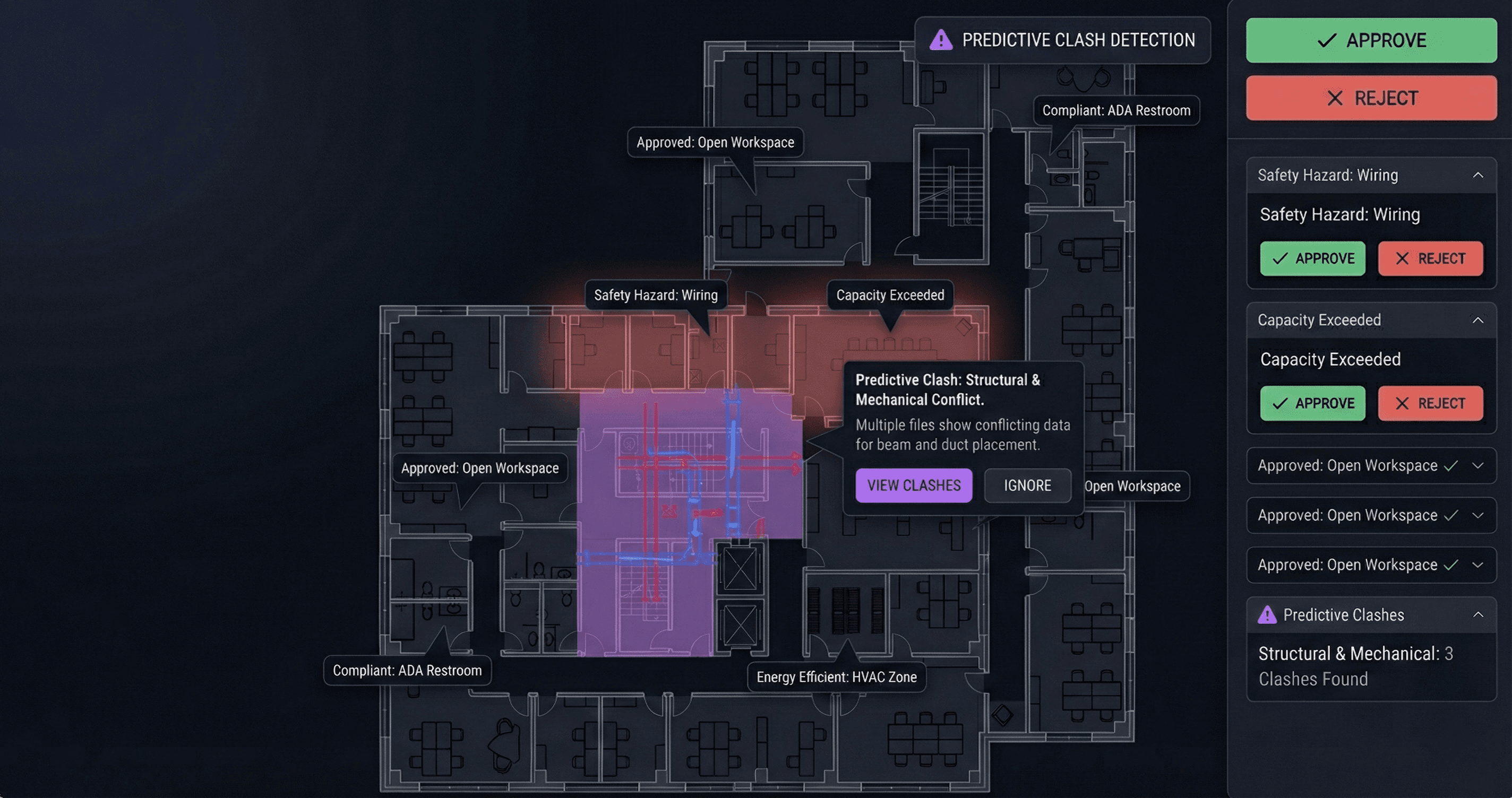
Predictive Clash Detection
Stop Reacting to Noise. Start Detecting Risk.
The "Updated RCP" Nightmare
A drawing issue arrives. "Minor update," the architect says. The reflected ceiling plan now includes additional insulation for compliance. Looks harmless. It isn't.
The Hidden Constraint
That extra insulation reduces ceiling void depth. Mechanical isn't notified. Hydraulics works off the previous set. On paper, nothing clashes. In reality, it already does.
The Ripple Effect
One uncoordinated change triggers a cascade of downstream impacts:
Services: Ductwork and pipework no longer fit the available void.
Re-routing: Mechanical drops below ceiling or reroutes entirely.
Design impact: Bulkheads appear where they were never allowed.
Rework: Services, ceilings, and layouts all need redesign.
Delay: Procurement pauses while teams "confirm clearances."
The Result? Risk That Can't Be Recovered
By the time the issue is discovered, the project has already moved. The change is treated as coordination—not a variation. The redesign, delays, and unclaimable preliminaries sit with the builder. A "minor update" quietly becomes a margin leak.
Stop Finding Clashes on Site. Start Predicting Them.
Coordination failures shouldn't be discovered on site. Predictive Clash Detection identifies downstream impacts the moment drawings change—before services are designed, priced, or installed.
Drawings don't fail all at once. They fail quietly—until they cost money.
SEE CIM IN ACTION
Stop Reacting to Noise. Start Detecting Risk.
The "Updated RCP" Nightmare
A drawing issue arrives. "Minor update," the architect says. The reflected ceiling plan now includes additional insulation for compliance. Looks harmless. It isn't.
The Hidden Constraint
That extra insulation reduces ceiling void depth. Mechanical isn't notified. Hydraulics works off the previous set. On paper, nothing clashes. In reality, it already does.
The Ripple Effect
One uncoordinated change triggers a cascade of downstream impacts:
Services: Ductwork and pipework no longer fit the available void.
Re-routing: Mechanical drops below ceiling or reroutes entirely.
Design impact: Bulkheads appear where they were never allowed.
Rework: Services, ceilings, and layouts all need redesign.
Delay: Procurement pauses while teams "confirm clearances."
The Result? Risk That Can't Be Recovered
By the time the issue is discovered, the project has already moved. The change is treated as coordination—not a variation. The redesign, delays, and unclaimable preliminaries sit with the builder. A "minor update" quietly becomes a margin leak.
Stop Finding Clashes on Site. Start Predicting Them.
Coordination failures shouldn't be discovered on site. Predictive Clash Detection identifies downstream impacts the moment drawings change—before services are designed, priced, or installed.
Drawings don't fail all at once. They fail quietly—until they cost money.